Decision Guide to Coenzyme Q10 Raw Material Selection
As an industry expert specializing in the nutraceutical supply chain, we constantly observe the friction between formulation science and commercial viability. Brand owners, formulators, and supply chain managers are routinely tasked with developing products that not only deliver measurable physiological results but also maintain sustainable profit margins. The Coenzyme Q10 (CoQ10) category presents one of the most classic procurement dilemmas: selecting between Ubiquinone and Ubiquinol. This consultative guide is designed to bypass superficial marketing claims and provide a data-backed, objective framework to optimize your next CoQ10 product launch. Before diving deeper, let’s answer a fundamental question: what is coenzyme Q10? Simply put, it’s a vitamin-like compound found in every human cell, essential for energy production and antioxidant defense.
Navigating the CoQ10 Procurement Dilemma
For brand owners and formulators in the dietary supplement sector, Coenzyme Q10 remains a cornerstone ingredient for cardiovascular health, mitochondrial energy production, and healthy aging formulations. However, the decision at the procurement level is rarely straightforward. Choosing between the oxidized form (Ubiquinone) and the reduced, active form (Ubiquinol) requires a precise understanding of pharmacokinetics, target demographic biology, and raw material economics. When sourcing coenzyme Q10 bulk supplements, you must evaluate not only price per kilogram but also how the ingredient performs in real-world human metabolism.
Conversion Dynamics and Bioavailability of CoQ10
Deep Dive into Cellular Conversion
To make an informed raw material decision, formulators must first understand how CoQ10 behaves in vivo. Ubiquinone is the naturally occurring, oxidized state of Coenzyme Q10. When ingested, it serves as an electron acceptor. However, to participate in cellular antioxidant defense and ATP synthesis within the mitochondria, the human body must enzymatically reduce Ubiquinone into Ubiquinol.
This conversion relies heavily on enzymes such as NQO1 (NAD(P)H dehydrogenase [quinone] 1). In a healthy, young metabolic system, this reduction process is highly efficient. The body easily converts the stable, oxidized Ubiquinone into the active Ubiquinol required for neutralizing free radicals. However, this biological conversion is a rate-limiting step that becomes increasingly inefficient due to aging, metabolic stress, or pharmaceutical interference. For supplement formulators, understanding ubiquinol vs ubiquinone for supplement formulators is the first step toward designing products that truly meet the needs of different age groups.
3-4x Bioavailability Advantage of Reduced CoQ10
Bioavailability is the primary battleground where Ubiquinol proves its premium valuation. Because Ubiquinol already possesses two hydroxyl groups, it is significantly more hydrophilic than the highly lipophilic Ubiquinone. This structural difference allows Ubiquinol to form micelles in the digestive tract far more efficiently.
Clinical pharmacokinetic studies demonstrate that Ubiquinol offers a 3 to 4 times higher absorption rate compared to standard crystalline Ubiquinone. When measuring blood plasma CoQ10 concentrations post-supplementation, a 100mg dose of Ubiquinol routinely yields plasma peaks that would require 300mg to 400mg of conventional Ubiquinone to match. For formulators, this means achieving therapeutic thresholds with a significantly lower active payload. If you are searching for a reliable coenzyme Q10 bulk powder supplier, make sure they provide detailed bioavailability data for each form.
CoQ10 Formulating for the End-User
Understanding your brand's target audience is critical to raw material selection. The physiological state of the consumer dictates the utility of the ingredient.
Ubiquinone is The Preventative Approach for the Young and Healthy
For sports nutrition brands, general daily multivitamins, or energy supplements targeting consumers under the age of 40, Ubiquinone is the optimal choice. Younger demographics possess robust enzymatic conversion capabilities. Their bodies can seamlessly synthesize and reduce exogenous Ubiquinone into Ubiquinol. In this context, utilizing the more expensive Ubiquinol yields diminishing returns, making Ubiquinone the smartest strategic choice for preventative health and general vitality formulas. When purchasing coenzyme Q10 bulk supplements for a younger audience, always prioritize cost-efficiency without compromising on purity.
Ubiquinol is The Therapeutic Choice for the Elderly and Statin Users
Conversely, cardiovascular supplements and anti-aging formulas targeting consumers over 40 must prioritize Ubiquinol. As humans age, the liver's ability to synthesize CoQ10 and the body's capacity to convert Ubiquinone into Ubiquinol sharply declines. Furthermore, individuals undergoing statin therapy (HMG-CoA reductase inhibitors) experience profound depletion of systemic CoQ10 levels. For these demographics, providing pre-converted, active Ubiquinol bypasses the compromised enzymatic bottleneck, delivering direct and immediate mitochondrial support.
Cost-Benefit Analysis and Market Projections of CoQ10
CoQ10 Pricing and Absorption Efficiency
Supply chain managers frequently push back against Ubiquinol due to its premium raw material cost, which can be considerably higher per kilogram than standard Ubiquinone. However, an accurate cost-benefit analysis must be calculated based on "cost per absorbed milligram" rather than strict raw material weight.
If Ubiquinol provides a 3-4x absorption advantage, the formulation can utilize a smaller dose (e.g., 50mg of Ubiquinol instead of 200mg of Ubiquinone) to achieve identical therapeutic outcomes. This smaller payload frees up capsule space for secondary active ingredients and narrows the actual cost-of-goods-sold (COGS) gap between the two forms. A trustworthy coenzyme Q10 bulk powder supplier will provide you with both forms and help you model these economics.
Market Data and Future Trajectory
The market reflects a distinct shift toward advanced delivery and active-form ingredients. By 2025, the global market for standard Ubiquinone is projected to reach $430 million. However, the Ubiquinol segment is expected to surpass it, reaching $454 million by 2025 . This transition is being driven by a robust Compound Annual Growth Rate (CAGR) of 6.3% for Ubiquinol, fueled by an aging global population, increased statin prescriptions, and heightened consumer education regarding bioavailability. Brands that align their procurement with these shifting market dynamics will be positioned for superior commercial growth. For those who ask what is coenzyme Q10 in the context of market trends, the answer is clear: it’s a growing category with two distinct strategic paths.
Overcoming CoQ10 Formulation Hurdles
Selecting the raw material is only half the battle; integrating it into a stable, consumer-friendly product requires specific technical solutions.
Utilizing Kaneka Sources
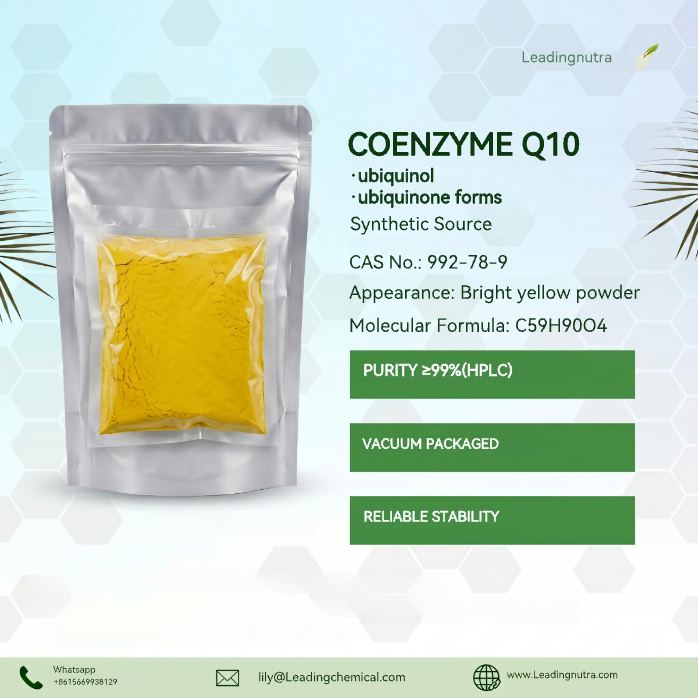
For Ubiquinol, Kaneka Ubiquinol™ remains the industry gold standard. Originating from yeast fermentation, it is bio-identical to the CoQ10 produced by the human body. Sourcing from established patent holders ensures consistent purity and protects brands from potential intellectual property infringement disputes that arise with synthetic alternatives. When verifying raw material identity, always check the coenzyme Q10 CAS.992-78-9 (note: the correct CAS for bio-identical Ubiquinol is 992-78-9, while Ubiquinone is 303-98-0; your supplier must distinguish them).
Micronization for Ubiquinone Dissolution
If supply chain constraints dictate the use of Ubiquinone, formulators must address its poor bioavailability. The most effective technical solution is micronization. By drastically reducing the particle size of the CoQ10 crystals, the surface area exposed to gastrointestinal fluids increases, significantly improving dissolution and closing the absorption gap between Ubiquinone and Ubiquinol.
Water-Soluble Delivery Systems of CoQ10
Modern consumers demand alternative delivery formats like gummies, liquid shots, and functional beverages. Because both forms of CoQ10 are inherently lipophilic, integrating them into aqueous environments is challenging. We highly recommend utilizing Cold Water Soluble (CWS) CoQ10 powders. These systems utilize liposomal encapsulation or nano-emulsion technologies, embedding the CoQ10 into a hydrophilic matrix that prevents precipitation and enhances systemic absorption.
FAQ
Which form is better for a premium cardiovascular supplement?
For premium, high-ticket cardiovascular formulas, Ubiquinol is the definitive choice. Its superior absorption and direct utilization cater precisely to the compromised metabolic states of cardiovascular patients and statin users.
Can Ubiquinone and Ubiquinol be blended in a single formula?
While biochemically possible, it is commercially redundant. Consumers purchasing an Ubiquinol product are paying for the pre-converted active form. Blending the two dilutes the primary value proposition of the product and complicates stability testing without offering a synergistic benefit.
How do we manage the stability challenges of Ubiquinol during manufacturing?
Ubiquinol is susceptible to oxidation, reverting to Ubiquinone if exposed to air and light. Contract manufacturers must utilize closed, nitrogen-flushed environments during blending and encapsulation. Softgels with opaque coatings are the preferred delivery format to ensure shelf-life stability.
Does the higher raw material cost of Ubiquinol translate to lower margins?
Not necessarily. While the cost per kilogram is higher, the premium positioning of Ubiquinol allows brands to command a higher retail price point. Furthermore, achieving therapeutic claims requires a lower milligram dose, which can balance the unit economics. Always partner with an experienced coenzyme Q10 bulk powder supplier to optimize your COGS.
Are there intellectual property constraints when sourcing Ubiquinol?
Yes. Kaneka holds significant patents regarding the manufacturing and stabilization of Ubiquinol. Supply chain managers must ensure their raw material suppliers have the appropriate licensing to avoid costly litigation and product recalls. And when you evaluate a new vendor, don’t forget to ask for the coenzyme Q10 CAS.992-78-9 certificate of analysis to confirm you’re getting genuine reduced-form CoQ10.
Ubiquinone and Ubiquinol
The choice between Ubiquinone and Ubiquinol is not a matter of one being universally superior; it is a matter of precise formulation alignment. By matching the biochemical realities of these ingredients to the specific biological needs of your target demographic, while factoring in the 3-4x bioavailability multiplier against raw material costs, brands can engineer CoQ10 supplements that succeed both physiologically and commercially.
Leadingnutra your premium coenzyme Q10 bulk powder supplier, offering both Ubiquinone and Ubiquinol with verified CAS.992-78-9 and third-party testing. Contact us today for technical sheets, free samples, and formulation support.
References
[1] American Heart Journal (AHJ): Pharmacokinetics and Bioavailability of Coenzyme Q10 Formulations.
[2] Circulation: The Impact of Statin Therapy on Systemic Coenzyme Q10 Depletion and Enzymatic Reduction Constraints.
[3] National Institutes of Health (NIH) – Office of Dietary Supplements: Coenzyme Q10 Fact Sheet for Health Professionals.
[4] PubMed Central (PMC): Comparative Bioavailability of Ubiquinol and Ubiquinone in Healthy Volunteers – A Randomized Crossover Study.
[5] Journal of Clinical Medicine: The Role of Coenzyme Q10 in Cardiovascular Diseases – A Systematic Review.
2026.04.22