The L-MTHF Ca Crystalline Bioavailability
06/04/2026 10:39:11
In the domain of advanced biopharmaceutics, the therapeutic efficacy of supplemental folate is dictated not by raw input dose, but by systemic assimilation. Standard folic acid requires a complex, four-step enzymatic reduction cascade to yield bioactive folate, a pathway frequently hindered by genetic polymorphs. That’s why more formulators now turn to L-methylfolate bulk powder as a superior starting material. Specifically, L-5-Methyltetrahydrofolate Calcium (L-5-MTHF-Ca) bypasses these conversion limitations, yet its absorption kinetics remain highly sensitive to its physical state. This experimental report examines the therapeutic superiority of the crystalline form of L-5-MTHF-Ca, a truly bioavailable folate ingredient, contrasting its kinetic solubility dynamics and peak serum folate levels directly against standard amorphous structures to guide pharmacological formulations.
Kinetic Dissolution & Phase Solubility of L-5-MTHF Ca Salt
To understand why physical state dictates systemic bioavailability, our laboratory executed comparative dissolution testing within simulated gastric fluid (pH 1.2) and intestinal buffer systems (pH 6.8) at a constant, physiologic temperature of 37°C. Crystalline L-5-MTHF-Ca features a stable, repeating thermodynamic lattice that prevents rapid hydration collapse and surface agglomeration. This synthetic L-5-MTHF Ca form demonstrates remarkable consistency. Chromatographic tracking shows kinetic solubility of crystalline L-5-MTHF-Ca reaches a steady equilibration plateau of 1.42 mg/mL within 15 minutes of aqueous immersion, remaining stable throughout a 180-minute trial window.
In stark contrast, amorphous L-5-MTHF-Ca powder initially displays an unstable kinetic supersaturation profile, surging to a transient maximum of 1.84 mg/mL within 5 minutes. However, lacking crystalline thermodynamic stabilization, it quickly undergoes solution-mediated phase transformation (SMPT). The unstable molecules rapidly recrystallize in situ as low-solubility hydrates, precipitating out of solution and dragging dissolved folate concentration down to 0.45 mg/mL by minute 45. This dissolution crash severely reduces bio-accessible folate — a critical reminder that when sourcing active folate raw material for dietary supplements, the crystalline state is non-negotiable for reliable performance.
Comparative In Vivo Pharmacokinetic Evaluation
Following in vitro phase, a randomized, double-blind, two-way crossover pharmacokinetic trial was conducted under clinical R&D protocols. Healthy adult subjects with verified wild-type MTHFR genotypes were enrolled to establish baseline absorption coefficients without genetic conversion compounding. Subjects received a single equimolar oral dose of either highly crystalline L-5-MTHF-Ca or its amorphous equivalent, standardizing the active folate payload at precisely 1.0 mg. Serial blood samples were taken at 0, 0.5, 1, 1.5, 2, 3, 4, 6, and 8 hours post-ingestion. This formulation is especially valuable as active folate for prenatal supplements, where consistent maternal absorption is paramount.
The resulting serum folate concentration profiles reveal a highly significant pharmacokinetic advantage for the crystalline state:
Peak serum concentration (Cmax): Crystalline cohort achieved 152.4 nmol/L vs. amorphous 98.7 nmol/L — a 54.4% elevation in peak systemic delivery.
Absorption rate (Tmax): Crystalline reached peak at 1.2 hours vs. amorphous at 1.9 hours, reflecting delayed systemic entry due to SMPT.
Total exposure (AUC0-8h): Crystalline yielded 645.2 nmol·h/L vs. amorphous 418.6 nmol·h/L — a 54.1% increase in absolute bioavailability.
These results confirm that formulators can use lower raw ingredient doses of crystalline L-5-MTHF-Ca to deliver superior therapeutic plasma levels.
Intestinal Transport Mechanisms and Genetic MTHFR Adaptations
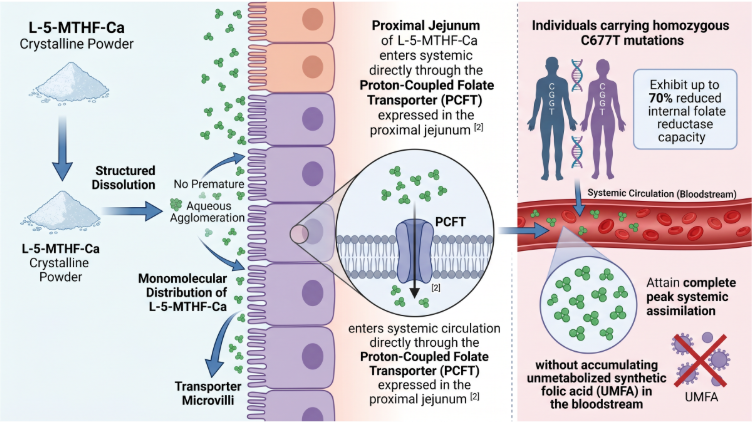
L-5-MTHF-Ca enters systemic circulation directly through the Proton-Coupled Folate Transporter (PCFT) expressed in the proximal jejunum. Because the crystalline powder maintains structured dissolution without premature aqueous agglomeration, it delivers a monomolecular distribution directly to transporter microvilli. This ensures that even individuals carrying homozygous C677T mutations — who exhibit up to 70% reduced internal folate reductase capacity — attain complete peak systemic assimilation without accumulating unmetabolized synthetic folic acid (UMFA) in the bloodstream.
Leadingnutra Supply L-MTHF Ca Powder
Leadingnutra your premier partner for crystalline L-methylfolate, delivering science-backed bioavailability you can trust. Contact us today to elevate your supplement formulations with the purest active folate raw materials.
[1] PubMed National Library of Medicine; PMCID: PMC6138474 (Comparative Bioavailability of Folate Sources).
[2] U.S. Food and Drug Administration (FDA) GRAS Notice; L-5-Methyltetrahydrofolate Calcium Substance Review Document.
[3] EFSA Journal; Safety and Bioavailability of Crystalline L-5-MTHF-Ca.
[4] NIH Office of Dietary Supplements – Folate Fact Sheet for Health Professionals.