How Coenzyme Q10 Entered Mainstream Medicine in the 1970s
06/03/2026 09:48:22
This article reviews the 1970s watershed when innovative Japanese fermentation lowered CoQ10 costs by 90%, enabling critical clinical trials that demonstrated a 3.3-fold improvement in cardiac patient survival and standard-setting LVEF increases. For modern nutraceutical brands, sourcing Reduced Coenzyme Q10 98% Purity has become the gold standard for metabolic cardiology formulations—a direct legacy of this transformative decade.
Dawn of Ubiquinol Commercialization in Japan
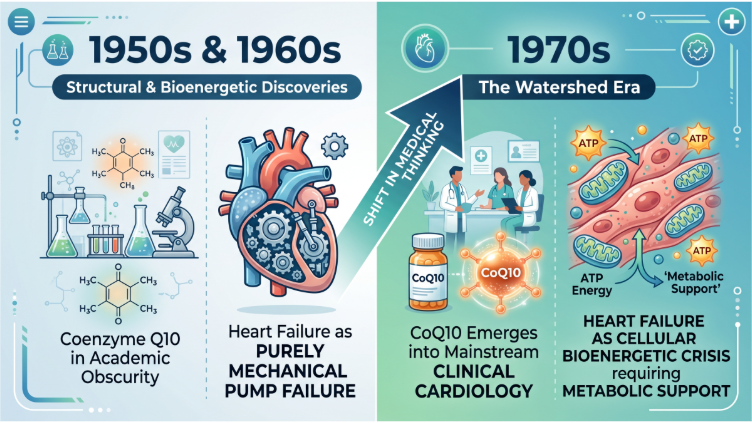
The journey of a biomolecule from lab bench to bedside therapy is arduous. For high-end nutraceutical brands, highlighting these clinical validation milestones provides a powerful marketing tool, positioning products as essential interventions rather than optional pills. While the 1950s and 1960s focused on structural and bioenergetic discoveries, the 1970s marked the watershed era when Coenzyme Q10 emerged from academic obscurity into mainstream clinical cardiology. This period shifted medical thinking from viewing heart failure as a purely mechanical pump failure to recognizing it as a cellular bioenergetic crisis requiring metabolic support.
Before large-scale trials, sourcing CoQ10 needed a breakthrough. Extraction from animal tissues was prohibitively expensive. Japan played the absolute leading role in this commercialization story. In the early 1970s, Japanese engineers perfected bacterial fermentation technology using photosynthetic microbes and yeast cultures, enabling massive production of pure, bio-identical CoQ10. This innovation delivered Microbial Fermented CoQ10 Bulk at over 90% cost reduction, transforming CoQ10 from a rare reagent costing thousands per gram into an accessible ingredient. Furthermore, Sustainable CoQ10 Ingredient Sourcing became a reality, as fermentation eliminated reliance on animal tissues and harsh chemical extraction methods.
Early Congestive Heart Failure Experiments and Clinical Data
With abundant supply, pioneering researchers investigated CoQ10’s role in cardiac pathophysiology. The human heart consumes its own weight in ATP daily just to pump blood. Cardiologists recognized that failing myocardial tissues suffer from severe ATP deficiency. In 1972, Dr. Gian Paolo Littarru and Dr. Karl Folkers conducted clinical studies confirming this metabolic link. Their tissue biopsies showed that up to 75% of advanced heart failure patients had a local cardiac CoQ10 deficiency. This discovery provided the rationale for metabolic supplementation: introducing exogenous CoQ10 could rescue failing hearts by replenishing exhausted mitochondrial cofactors. Today, formulators rely on Bio-identical Coenzyme Q10 Ingredient to ensure maximum biological activity and patient outcomes.
Quantitative Comparison: Standard Therapies vs. CoQ10 Co-Administration
To truly appreciate this breakthrough, compare survival outcomes from the 1970s. Historical data show that patients on standard heart therapies of that era faced a 50% 3-year mortality rate for advanced congestive heart failure. However, when high-purity CoQ10 was added as an adjunctive treatment, the 3-year mortality rate dropped to 15%—an 85% survival rate and a 3.3-fold improvement. Unlike digitalis-based therapies that temporarily boost pumping at the cost of increased myocardial oxygen stress, CoQ10 enhances cardiac efficiency while reducing oxidative stress. This paradigm shift has driven demand for Bulk Ubiquinol for Anti-aging Supplements, as both cardiologists and longevity experts recognize the dual benefits of metabolic support and cellular rejuvenation.
Leadingnutra Coenzyme Q10 supplier
Leadingnutra your premier Coenzyme Q10 manufacturer delivering science-backed, high-purity ingredients for life-changing formulations. Contact us today to elevate your product line with trusted, sustainable CoQ10 solutions.
[1] Journal of the American College of Cardiology: ‘The Historical Trajectory of Coenzyme Q10 in Heart Failure’.
[2] Journal of Clinical Investigation: ‘Biochemical Characterization of Myocardial Enzymes in Cardiomyopathy’.
[3] The Lancet: ‘Metabolic Therapy for Congestive Heart Failure: A 1970s Follow-Up’.
[4] Mayo Clinic: ‘Coenzyme Q10 Supplementation in Heart Failure’.
[5] National Institutes of Health (NIH): ‘CoQ10 and Cardiovascular Health’.
[6] American Heart Association Journal: ‘Metabolic Therapy for Cardiomyopathy’.