Fermentation PQQ is the Next-Generation Mitochondrial Energizer Backed by Global Regulatory Approvals
07/14/2025 10:37:16
The landscape of cognitive health and cellular energy supplementation is undergoing a structural shift. As consumers increasingly move away from transient stimulants like caffeine, the demand for sustained, non-stimulatory cellular energy enhancers has surged. At the forefront of this transition is Pyrroloquinoline quinone (PQQ) — a potent redox cofactor that fundamentally supports mitochondrial biogenesis and cellular defense mechanisms. But what is pyrroloquinoline quinone exactly? In simple terms, it’s a vitamin-like compound that helps your cells produce more energy while protecting them from oxidative damage. However, for brand owners and contract manufacturers (OEM/ODM), the source and production method of PQQ dictate both market viability and regulatory compliance. Fermentation-derived PQQ Disodium Salt (also known as Methoxatin disodium salt), characterized by its ultra-high purity (≥99%) and robust global regulatory approvals, has emerged as the definitive standard for premium dietary supplements and functional foods.
PQQ Supplement 8.75% CAGR in Cognitive Health
The commercial trajectory for PQQ is exceptionally robust. According to data from Verified Market Reports, the global PQQ market is projected to expand at a Compound Annual Growth Rate (CAGR) of 8.75% from 2025 to 2032. This growth is disproportionately driven by the cognitive health and healthy aging sectors, where consumers are actively seeking clinically validated ingredients.
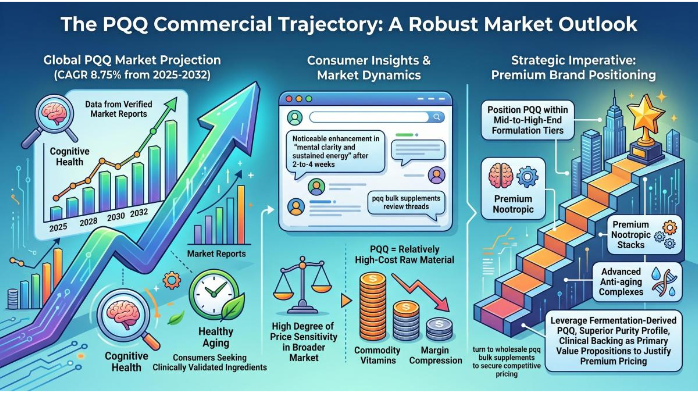
A deep dive into consumer sentiment across platforms like Amazon and Reddit reveals a distinct pattern. End-users consistently report a noticeable enhancement in “mental clarity and sustained energy” following a 2-to-4-week supplementation protocol. Many of these discussions also feature pqq bulk supplements review threads, where experienced users compare different brands and dosages. Interestingly, these same consumer insights highlight a high degree of price sensitivity in the broader market. Because PQQ is a relatively high-cost raw material compared to commodity vitamins, brands competing on price often face margin compression. That’s why smart formulators turn to wholesale pqq bulk supplements to secure competitive pricing without sacrificing quality. Therefore, the strategic imperative for brand owners is to position PQQ within mid-to-high-end formulation tiers. By leveraging fermentation-derived PQQ in premium nootropic stacks or advanced anti-aging complexes, brands can justify premium pricing, utilizing the ingredient’s superior purity profile and clinical backing as primary value propositions.
Methoxatin Mechanisms of Mitochondrial Biogenesis and Nrf2 Activation
The efficacy of PQQ is anchored in its profound impact on cellular signaling pathways, specifically those governing mitochondrial function and oxidative stress response. Unlike conventional antioxidants that neutralize free radicals on a 1:1 ratio, PQQ acts catalytically, capable of carrying out thousands of redox cycles before degrading.
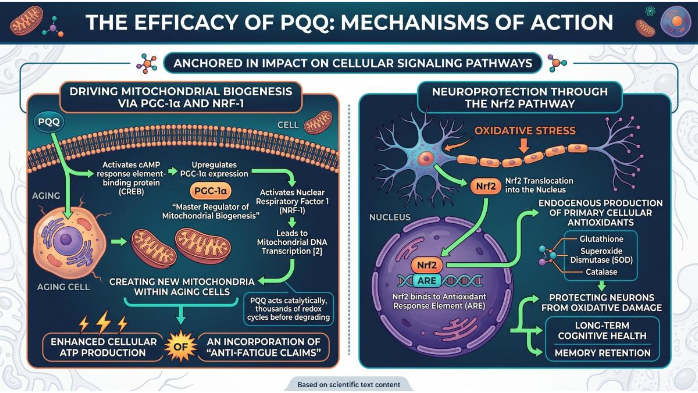
Driving Mitochondrial Biogenesis via PGC-1α and NRF-1
PQQ’s most distinguished physiological role is its ability to stimulate mitochondrial biogenesis—the creation of new mitochondria within aging cells. It achieves this by activating the cAMP response element-binding protein (CREB), which subsequently upregulates the expression of Peroxisome proliferator-activated receptor gamma coactivator 1-alpha (PGC-1α). PGC-1α is the master regulator of mitochondrial biogenesis. This cascade further activates Nuclear Respiratory Factor 1 (NRF-1), leading to the transcription of mitochondrial DNA. For the consumer, this translates to enhanced cellular ATP production, offering a physiological basis for anti-fatigue claims.
Neuroprotection Through the Nrf2 Pathway
In addition to energy metabolism, PQQ provides robust neuroprotection by activating the Nrf2 (Nuclear factor erythroid 2-related factor 2) pathway. Under conditions of oxidative stress, PQQ facilitates the translocation of Nrf2 into the nucleus, where it binds to the Antioxidant Response Element (ARE). This triggers the endogenous production of primary cellular antioxidants, such as glutathione, superoxide dismutase (SOD), and catalase. This mechanism is critical for protecting neurons from oxidative damage, thereby supporting long-term cognitive health and memory retention.
The Quality between Fermentation and Chemical Synthesis of PQQ
For nutraceutical manufacturers, the choice between fermentation-derived and chemically synthesized PQQ is a critical formulation decision. While chemical synthesis can yield PQQ, it inherently carries risks related to toxic solvent residues and isomeric impurities. Fermentation, utilizing specialized bacterial strains, mimics the natural biosynthesis of PQQ, yielding a vastly superior product. And for those who need to verify the identity of their raw material, the PQQ CAS No.122628-50-6 (which corresponds to Methoxatin disodium salt) serves as the universal reference for regulatory documentation and quality control.
Comparative Analysis of PQQ Production Methods
Comparative Analysis of PQQ disodium vs, Acid Form
| Parameter |
Fermentation-Derived PQQ Disodium Salt |
Chemically Synthesized PQQ |
| Purity |
≥99% (Highly purified, natural isomer) |
Often <98% (Risk of structural isomers) |
| Solvent Residues |
Zero harsh chemical solvents used |
Potential for trace hazardous solvents |
| Safety Profile |
Clinically validated, high biocompatibility |
Requires stringent residue testing |
| Batch Stability |
Exceptionally high consistency |
Variable depending on purification steps |
| Environmental Impact |
Eco-friendly, sustainable bioprocess |
High chemical waste and energy footprint |
Fermentation-derived PQQ Disodium Salt offers unparalleled batch-to-batch stability. This consistency is vital for contract manufacturers who must ensure that every production run meets exact label claims without degradation during the blending and encapsulation processes.
The Global Regulatory Landscape for PQQ Ingredient Formulation
A premium ingredient is only as valuable as its regulatory standing. Fermentation-derived PQQ Disodium Salt boasts a comprehensive portfolio of global safety certifications, mitigating compliance risks for export-oriented brands.
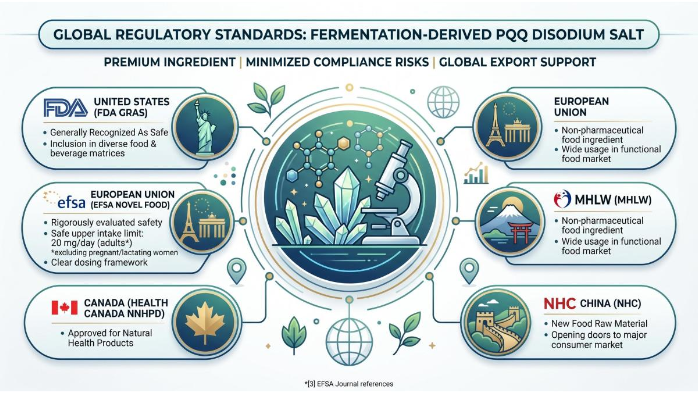
The regulatory milestones include:
FDA GRAS (Generally Recognized As Safe): Allowing its inclusion in a variety of food and beverage matrices in the United States.
EFSA Novel Food: The European Food Safety Authority has rigorously evaluated PQQ, establishing a safe upper intake limit of 20 mg/day for the general adult population (excluding pregnant and lactating women) . This precise dosing guideline provides a clear framework for European formulations.
MHLW (Japan): Classified as a non-pharmaceutical food ingredient, enabling wide usage in the Japanese functional food market.
Health Canada NNHPD: Approved for use in Natural Health Products.
China NHC: Approved as a New Food Raw Material, opening doors to one of the world’s largest consumer markets.
Formulation Applications Beyond Traditional Capsules
The physicochemical properties of fermentation-derived PQQ Disodium Salt—specifically its excellent water solubility and thermal stability—make it a highly versatile ingredient for modern delivery formats.
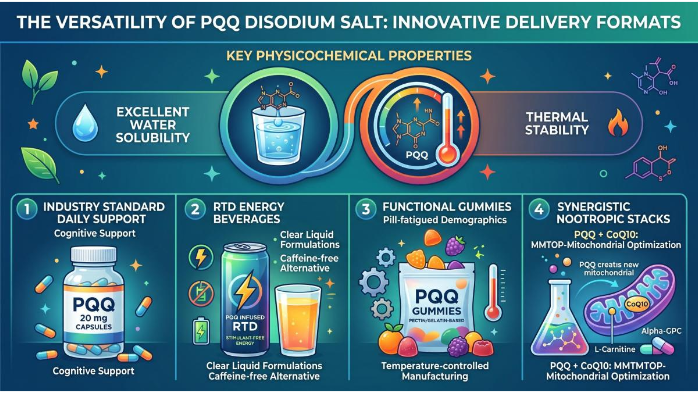
While 20 mg capsules remain the industry standard for daily cognitive support, innovative brands are integrating PQQ into diverse matrices:
Ready-to-Drink (RTD) Energy Beverages: PQQ’s solubility allows for clear liquid formulations, offering a stimulant-free energy alternative to traditional caffeine-loaded drinks.
Functional Gummies: With strict control over manufacturing temperatures, PQQ can be successfully incorporated into pectin or gelatin-based gummies, appealing to pill-fatigued demographics.
Synergistic Nootropic Stacks: PQQ is increasingly formulated alongside Coenzyme Q10 (CoQ10), L-Carnitine, and Alpha-GPC. The combination of PQQ and CoQ10 is particularly potent, as PQQ generates new mitochondria while CoQ10 optimizes the electron transport chain within them.
Elevate Your Product Line with Premium PQQ Disodium Salt
In a market projected to grow at an 8.75% CAGR, securing a high-purity, regulatory-compliant source of PQQ is paramount for brand differentiation. Whether you’re reading a pqq bulk supplements review to gauge consumer expectations or searching for reliable wholesale pqq bulk supplements to scale your production, the science points to one conclusion: fermentation-derived PQQ Disodium Salt (PQQ CAS No.122628-50-6, also called Methoxatin disodium salt) is the gold standard. Our fermentation-derived PQQ Disodium Salt (≥99% purity) meets the most stringent global standards, ensuring safety, efficacy, and formulation versatility for your next-generation cognitive and energy products.
Leadingnutra your trusted partner for fermentation-derived PQQ disodium salt(https://www.leadingnutra.com/products/detail/2.html), delivering unmatched purity, global compliance, and sustainable innovation. Get in touch with us now to unlock competitive wholesale pricing and expert formulation support. Ready to upgrade your formulation? Contact our technical sales team today to request a comprehensive Technical Data Sheet (TDS), Certificate of Analysis (COA), or a free sample for your R&D trials. Email: lily@leadingchemical.com
References
[1] Verified Market Reports. (2024). Global Pyrroloquinoline Quinone (PQQ) Market Size, Share & Industry Analysis.
[2] Chowanadisai, W., et al. (2010). Pyrroloquinoline quinone stimulates mitochondrial biogenesis through cAMP response element-binding protein phosphorylation and increased PGC-1alpha expression. The Journal of Biological Chemistry, 285(1), 142-152.
[3] EFSA Panel on Dietetic Products, Nutrition and Allergies (NDA). (2017). Safety of pyrroloquinoline quinone disodium salt as a novel food pursuant to Regulation (EC) No 258/97. EFSA Journal, 15(11), 5058.
[4] National Institutes of Health (NIH) – Office of Dietary Supplements. (2022). PQQ: Emerging Evidence for Mitochondrial Health.
[5] Harvard T.H. Chan School of Public Health. (2023). The Role of Pyrroloquinoline Quinone in Cellular Energy Metabolism.