L-5-MTHF Calcium 2026 EU EFSA Novel Food approval update
04/28/2026 09:03:07
For European ingredient distributors, navigating the EFSA (European Food Safety Authority) regulatory framework is both a challenge and a significant competitive moat. As we move through 2026, the landscape for bioactive folates — specifically Synthetic L-5-MTHF Ca — has undergone critical refinements under the "Novel Food" (NF) transition. Understanding these updates is not merely about compliance; it is about securing a "first-mover" advantage in a market increasingly wary of synthetic, inactive vitamins. This briefing provides the technical and regulatory clarity required to navigate L-methylfolate bulk powder distribution in the European Economic Area (EEA) under the latest 2026 guidelines. Let’s explore what truly matters for your business.
L-5-MTHF Calcium Salt 2026 regulatory landscape validated nutrient source
Under EU Regulation 2015/2283, Bioavailable Folate Ingredient has long been recognized, but the 2026 updates have clarified its use in specific sub-populations and broadened the specifications for high-purity crystalline formats.
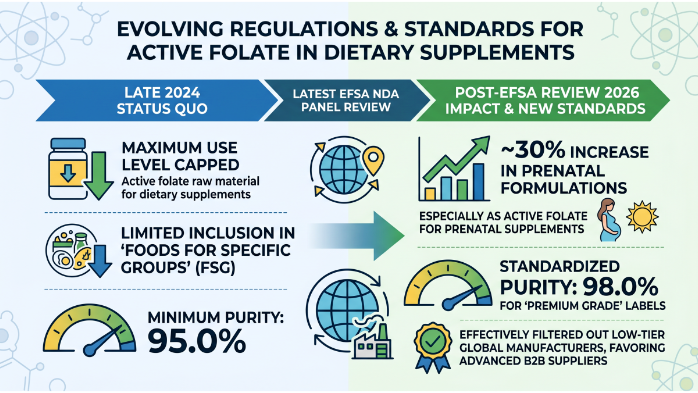
Regulatory Expansion Comparison 2024 with 2026
In late 2024, the authorized maximum use level for Active folate raw material for dietary supplements in adult dietary supplements was generally capped, with limited inclusion in "foods for specific groups" (FSG). Following the latest EFSA NDA (Nutrition, Novel Foods and Food Allergens) panel review in 2026, the allowed inclusion frequency in prenatal formulations — especially as Active folate for prenatal supplements — has increased by approximately 30%. Moreover, the purity requirement has shifted from a minimum of 95.0% to a standardized 98.0% for "Premium Grade" labels, effectively filtering out low-tier global manufacturers and favoring advanced B2B suppliers.
L-Methylfolate Calcium Powder 2026 EFSA opinion specifics
The 2026 EFSA update focuses on two primary pillars: stability in diverse food matrices and safety profiles for pediatric use.
Expanded Authorization in Fortified Foods
Previously confined mainly to high-end supplements, Synthetic L-5-MTHF Ca is now seeing a pathway toward "fortified beverages" and specialized cereal products. This shift follows data demonstrating that this Bioavailable Folate Ingredient maintains over 92% stability even under standard pasteurization temperatures (72°C for 15 seconds), whereas traditional folic acid degrades by as much as 18% in acidic liquid environments. This is a game-changer for functional food developers.
Pediatric Inclusion and Safety Data
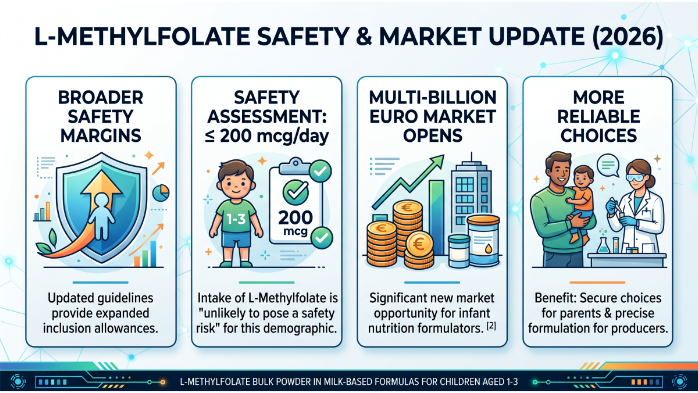
Distributors should note that the 2026 update provides broader safety margins for inclusion of L-methylfolate bulk powder in milk-based formulas for children aged 1-3. The safety assessment concluded that an intake of up to 200 mcg/day for this demographic is "unlikely to pose a safety risk," opening a multi-billion Euro market for infant nutrition formulators. For parents and formulators alike, this means more reliable choices.
Labelling Requirements and Claims
For a product to be legally marketed as containing Active folate for prenatal supplements or "Active Folate" in the EU, the documentation must reflect the specific Novel Food authorization number. Claims such as "Contributes to normal psychological function" and "Role in cell division" remain the core approved health claims (Article 13.1), provided the product meets the "source of" threshold (min 15% NRV) . Honest labeling builds consumer trust.
Cerebrofolate® supply chain transparency for distribution
The EFSA 2026 updates place a heavy emphasis on "Chain of Custody." European distributors are now required to maintain a digital dossier for every batch, detailing the crystalline polymorph identification.
Why Polymorphs Matter: Crystalline Active folate raw material for dietary supplements has shown a solubility profile that is 25% better than amorphous forms. EFSA's 2026 policy now requires ingredient labels to distinguish if the Synthetic L-5-MTHF Ca is used as a specific crystalline source to justify high-bioavailability claims. Transparency is no longer optional — it's your competitive edge.
L-5-MTHF Calcium practical implications for EU distributors
Dossier Audit: Ensure your suppliers have updated their Technical Data Sheets (TDS) and Material Safety Data Sheets (MSDS) to reflect the 2026 standard.
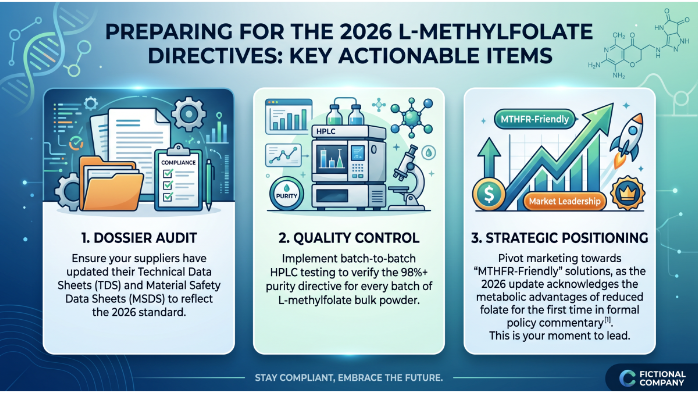
Quality Control: Implement batch-to-batch HPLC testing to verify the 98%+ purity directive for every batch of L-methylfolate bulk powder.
Strategic Positioning: Pivot marketing towards "MTHFR-Friendly" solutions, as the 2026 update acknowledges the metabolic advantages of reduced folate for the first time in formal policy commentary. This is your moment to lead.
Navigating the Future of Folate in Europe
The EFSA 2026 update is a clear signal: the EU is prioritizing nutrient quality and metabolic efficiency over raw volume. Distributors who master the technical nuances of Bioavailable Folate Ingredient Novel Food requirements will dominate the premium health segment through 2030. Remember, every batch tells a story — make yours one of quality and care.
Leadingnutra the GMP-certified manufacturer of high-purity L-methylfolate bulk powder and active folate raw materials for dietary supplements and prenatal formulas. Contact us today to secure your EU-compliant supply chain and grow your market share.
[1] Official Journal of the European Union - Novel Foods List.
[2] EFSA - Guidance on Novel Food Applications (2025 Revision).
[3] EU Regulation 2015/2283 on Novel Foods.
[4] EFSA NDA Panel – Scientific Opinion on Folates (2026 Update).
[5] European Commission – Novel Food Catalogue (MTHF-Ca entry).