Why Coenzyme Q10 Must Be Kept Strictly Protected from Light
06/09/2026 09:02:56
In the global supply chain of dietary supplements, premium raw materials undergo strict handling protocols. However, Coenzyme Q10 (ubiquinone) presents unique challenges. Manufacturers often incur heavy financial losses due to quality deviations, usually traced back to improper storage. This article exposes the photochemical vulnerability of ubiquinone, explaining the degradative pathways and the resulting inactive impurities that arise when this compound is exposed to light. By educating purchasing departments on the chemical photodecomposition processes of CoQ10, we aim to prevent quality complaints, optimize the raw material lifecycle, and demonstrate our absolute commitment to quality control. When you choose a Bio-identical Coenzyme Q10 Ingredient like ours, you can trust that every batch has been handled with zero light compromise from day one.
Photochemical Cleavage & Isomerization Co Q10 Mechanism
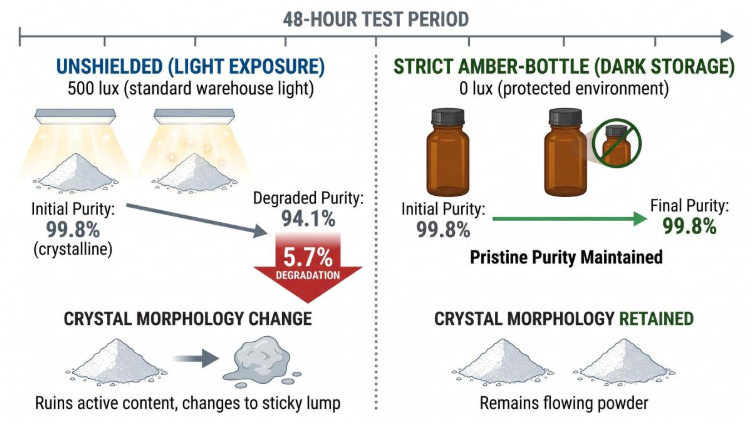
The primary driver of light-induced degradation in Coenzyme Q10 is its conjugated 1,4-benzoquinone moiety. This chromophore exhibits a strong absorption spectrum in the ultraviolet and visible region, specifically peaking at wavelengths between 270 nm and 410 nm. When exposed to ambient light, the benzoquinone core absorbs photons, entering an unstable singlet and subsequent triplet excited state. This state triggers a sequence of radical reactions, leading to photolysis. Specifically, the methoxy groups positioned at carbons 2 and 3 of the quinone ring undergo photolytic cleavage, yielding demethoxy-ubiquinone and quinone radical intermediates. Quantitative photostability tests show that under light exposure of 500 lux (standard warehouse light) for 48 hours, unshielded crystalline CoQ10 powder degrades from 99.8% purity to 94.1% purity. In contrast, under strict amber-bottle dark storage (0 lux), CoQ10 maintains a pristine purity of 99.8% over the same duration. This photo-induced degradation of 5.not only ruins the active content but also changes the crystal morphology from a dry flowing powder to a sticky, unmanageable lump. For formulators looking for Microbial Fermented CoQ10 Bulk with superior stability, our dark-protected process ensures that the natural crystal structure remains intact.
Degradation Products and Analytical Detection Protocols
As photochemical cleavage progresses, the CoQ10 matrix accumulates several degradation isomers, chiefly photo-ubiquinone-10 and allied polar photoproducts. High-Performance Liquid Chromatography (HPLC) is the standard method used to detect these impurities. On a standard reverse-phase C18 column, under ultraviolet detection at 275 nm, fresh dark-kept CoQ10 exhibits a single sharp peak with negligible impurity trace (<0.02%). In contrast, light-degraded raw material displays a major degradation impurity peak at a relative retention time (RRT) of 0. indicating the accumulation of photolysates [3]. Analytical comparison reveals that this 0.85 RRT impurity peak can increase by up to 52-fold in photo-exposed samples compared to our strict amber-glass dark control. These degradation products are biologically inactive and can cause mild cellular toxicity due to their altered redox potential. Consequently, using light-compromised raw materials leads to failed assay testing, shortened product shelf-life, and costly formulation recalls. Maintaining a light-shielded workspace from receiving to blending is essential to prevent these quality issues. For manufacturers seeking Reduced Coenzyme Q10 98% Purity or other specialty forms, the same strict light protection applies—because any photon exposure will compromise even the most advanced ingredients.
Complete Lifecycle Protection
Our high-purity CoQ10 is stored in multi-layer amber vacuum bags and double-corrugated fiber drums, guaranteeing complete photo-insulation and helping our partners protect their investments. Whether you need Bulk Ubiquinol for Anti-aging Supplements or standard ubiquinone, our end-to-end dark handling protocols ensure that you receive exactly what you pay for—no hidden degradation, no bioactive loss. We also prioritize Sustainable CoQ10 Ingredient Sourcing by using renewable fermentation feedstocks and energy-efficient dark storage facilities, reducing waste while preserving potency. Trust Leadingutra to deliver ingredients that shine in performance because they’ve never seen the light.
Leadingutra Supply The Ingredient for Coenzyme Q10
Leadingutra – Your trusted Coenzyme Q10 manufacturer, delivering uncompromised quality from fermentation to final packaging. [Contact us] today for certified dark-chain CoQ10 solutions and bulk quotations.
Written by Market Director
----Jony Tang
[1] ScienceDirect: Journal of Pharmaceutical and Biomedical Analysis, Photodegradation kinetics and stability pathways of ubiquinone-10 in bulk and solution state. 
[2] USP Monographs: United States Pharmacopeia (USP43-NF38), Official guidelines for packaging, storage, and dark-integrity monitoring of dietary ingredients.
[3] PubMed: Journal of Nutritional Science and Vitaminology, Identification of photolytic degradation pathways and cytotoxicity profiles of photo-isomers.
[4] MDPI Antioxidants: Comprehensive review on light stability of coenzyme Q10 analogs in nutraceutical formulations.
[5] Wiley Online Library: Photoprotection strategies for labile bioactive compounds – a practical guide for bulk ingredient handlers.