Synthesis vs. Natural Extraction Analysis of Urolithin A
05/27/2026 15:40:43
The commercialization of Urolithin A (UA) represents a pivotal shift in the nutraceutical industry from simple raw botanical extracts to high-purity clinical-grade molecules. For procurement officers and manufacturers, the debate often centers on two primary sourcing methodologies: Total Chemical Synthesis and Natural Botanical Extraction. While "natural" remains a powerful marketing term, the technical manufacturing landscape reveals that scalability, stability, and purity often favor the synthetic route. Let’s be honest — when you’re looking for Bulk Urolithin A Powder to supply global brands, you need consistency, not seasonal surprises.
High Purity Urolithin A Manufacturing Process Divide
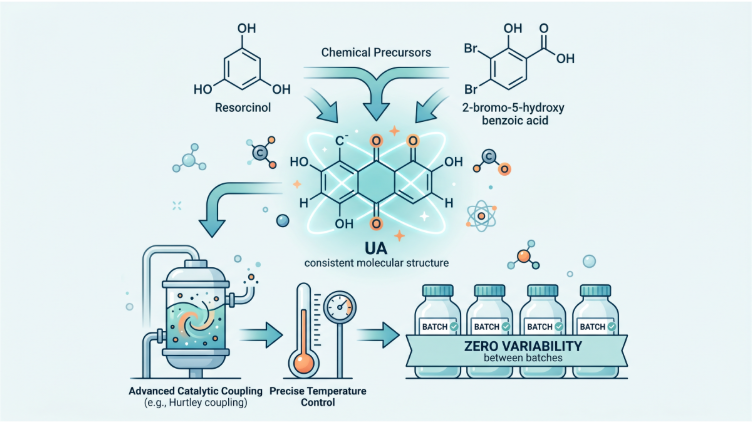
Total Synthesis: This process typically involves a multi-step chemical reaction starting from simple precursors like Resorcinol and 2-bromo-5-hydroxybenzoic acid. Through advanced catalytic coupling (such as Hurtley coupling) and precise temperature control, UA is built from the atoms up. This ensures a consistent molecular structure with zero variability between batches. Choosing a reliable Urolithin A Raw Material Supplier becomes straightforward when synthesis guarantees batch-to-batch identity.
Natural Extraction (and Microbial Fermentation): Producing UA from pomegranates involves either direct extraction of trace amounts (highly inefficient) or the microbial conversion of ellagic acid using specialized bioreactors. While technically "natural," this process is susceptible to biological drift, where the enzymatic efficiency of the microbes can vary based on substrate quality and oxygen levels . For Urolithin A Wholesale, such inconsistency can disrupt entire supply chains.
The Regulatory Advantage
In the context of the global supply chain, purity is the ultimate benchmark for safety and efficacy. Total synthesis allows for rigorous purification steps (such as recrystallization and HPLC) that can remove heavy metals and biological impurities common in raw materials.
Comparison of Typical Purity Levels:
- High-Grade Synthetic Urolithin A: 99.5% to 99.9% purity.
- Standard Natural Extraction: 90% to 95% purity, often containing residual polyphenols and waxes.
Furthermore, synthetic UA is free from the 14 major allergens, whereas pomegranate-derived extracts may carry trace sensitivities for certain populations. Even for specialized formats like Water-soluble Urolithin A, the synthetic platform offers cleaner intermediates and better downstream modification control.
Cost Scalability and Market Sustainability
The financial metrics of UA production are where the synthetic route demonstrates clear industrial dominance. Natural extraction is geographically constrained and tied to agricultural cycles, leading to significant price volatility.
Economic Comparison (Current Market Estimates):
- Synthetic Manufacturing Cost: Approximately 8,000−12,000 USD per Metric Ton (at scale).
- Natural Extraction Cost: Approximately 45,000−60,000 USD per Metric Ton equivalent (due to low yield).
Natural extraction requires nearly 50 tons of raw pomegranate input to produce a single kilogram of high-purity UA, making it environmentally and economically unsustainable for the mass market. This is why smart Urolithin A Ingredient Sourcing professionals now prioritize synthetic over botanical.
As Urolithin A moves toward wider adoption in functional foods and therapeutic beverages, the industry is gravitating toward total synthesis. The combination of pharmaceutical-grade purity and cost efficiency makes synthesized Urolithin A the only viable option for large-scale global distribution.
Leadingnutra The Urolithin A supplier
Leadingnutra your trusted partner for high-purity synthetic Urolithin A(https://www.leadingnutra.com/UrolithinA.html). Contact us today for bulk quotes and technical samples.
[1] Journal of Agricultural and Food Chemistry, "Chemical and Biological Synthesis of Urolithins,"
[2] Frontiers in Nutrition, "Large-Scale Production of Urolithin A,"
[3] ScienceDirect, "Comparison of Synthetic vs. Natural Bioactives,"
[4] Nature Reviews Chemistry, "Industrial Synthesis of Polyphenol Metabolites,"
[5] ACS Central Science, "Scalable Catalytic Approaches to Nature-Identical Compounds,"