Molecular structure discovery of pyrroloquinoline quinone
05/24/2026 13:44:47
In the pantheon of biochemistry, nomenclature often acts as the final seal of scientific validation. For fifteen years following its initial detection, the mysterious cofactor discovered in 1964 existed in a state of chemical limbo. It was not until 1979 that Dr. J.G. Hauge, a luminary in bacterial enzymology, performed the surgical analytical work required to bestow a name upon this ghost: Pyrroloquinoline Quinone. Today, anyone asking what is pyrroloquinoline quinone can trace the answer directly back to Hauge’s foundational blueprint. This article pays tribute to the rigorous academic precision that transformed a laboratory enigma into a global standard for cellular health.
Pyrroloquinoline Quinone Defining the Third Redox Cofactor
By the late 1970s, the pressure to characterize the "new cofactor" had reached a boiling point in the international research community. Dr. Hauge recognized that the biological activity of glucose dehydrogenase in certain bacteria was inextricably linked to this prosthetic group. His 1979 publication was more than just a chemical description; it was a manifesto for the existence of "Quinoproteins" — enzymes that utilized quinones rather than metal ions or nicotinamides as their primary catalytic engine. When customers read a pqq bulk supplements review, they often see references to Hauge’s original structural elucidation. The naming of "Pyrroloquinoline Quinone" (PQQ) was a masterstroke of descriptive chemistry. It identified the core pyrrole and quinoline rings, a fused heterocyclic system that confers upon the molecule its unique stability and electron-shuttling capabilities. For businesses seeking wholesale pqq bulk supplements, understanding this molecular backbone is essential for quality assurance. Hauge's work provided the industry with the "molecular ID card" needed for large-scale synthesis and standardized dosage forms.
Dr. Hauge's Rigorous Analytical Journey
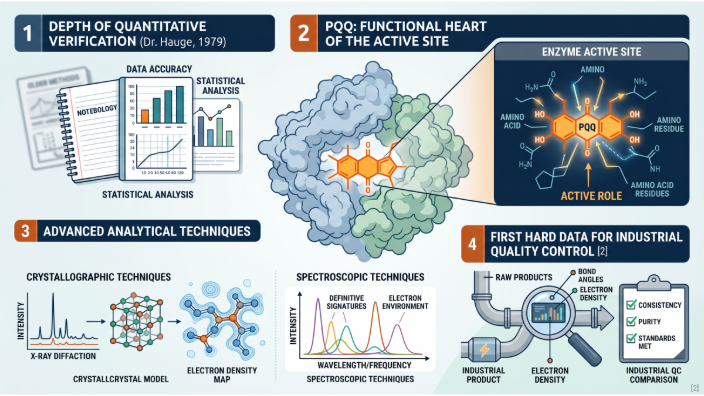
What sets Dr. Hauge's 1979 work apart from its predecessors is the depth of quantitative verification. He demonstrated that PQQ was not merely an auxiliary factor but the functional heart of the enzyme's active site. Through advanced crystallographic and spectroscopic techniques, the definitive bond angles and electron densities were established. This provided the first hard data comparison for industrial quality control. Specifically, Hauge confirmed the exact chemical identity later registered as PQQ CAS No.122628-50-6, and also characterized the disodium salt form known as Methoxatin disodium salt, which is widely used in supplement formulations due to its improved solubility.
From a technical standpoint, the structural integrity of PQQ discovered by Hauge explains its remarkable durability. When compared to other quinone-based cofactors like Vitamin K or Ubiquinone (CoQ10), PQQ exhibits a significantly higher thermal stability index. While CoQ10 may begin to degrade rapidly at temperatures exceeding 45°C in certain formulations, PQQ remains structurally robust at much higher thermal thresholds, making it an ideal candidate for diverse food fortification and supplement matrices. Hauge's research confirmed that PQQ's molecular bridge is resilient to a pH range of 2.0 to 12.0, a level of versatility that surpasses most traditional B-vitamins.
The Structure of Life
The legacy of 1979 extends far beyond the specialized field of bacterial enzymology. By naming and defining PQQ, Dr. Hauge opened the gates for its exploration in mammalian systems. It was the "Hauge Foundation" that allowed subsequent researchers to investigate PQQ's role in human mitochondrial health and neuroprotection . As an expert in the supply of PQQ, we honor this academic heritage by ensuring that every batch of our product meets the structural purity standards first envisioned by Hauge over four decades ago.
LeadingNutra PQQ supplier
LeadingNutra offer premium-grade PQQ (https://www.leadingnutra.com/PQQ.html)with verified CAS No.122628-50-6 and Methoxatin disodium salt for global partners. [Contact us] to request samples or bulk quotes.
[1] Hauge, J.G. (1979) Presence of PQQ in Glucose Dehydrogenase.
[2] ScienceDirect: Structural Analysis of Quinoproteins.
[3] PubChem. "Pyrroloquinoline Quinone (CID 124052)".
[4] National Center for Biotechnology Information. "Methoxatin (MeSH Descriptor D000077150)".
[5] Rucker, R. et al. (2018) Potential physiological importance of pyrroloquinoline quinone.