L-Theanine Biosynthesis vs. Chemical Pathways
05/23/2026 16:01:19
In the global market for cognitive enhancers, the distinction between production methods is often the decisive factor for pharmaceutical efficacy and consumer safety. As manufacturers seek to optimize yield, the industry has diverged into two primary pathways: traditional chemical synthesis and advanced enzymatic biosynthesis. For procurement specialists, understanding the molecular purity and economic implications of these methods is paramount. Whether you need Bulk L-theanine powder for large-scale nutraceutical formulations or specialized grades, the choice of production method directly impacts your final product's quality and market acceptance.
Enzymatic L-theanine bulk Gold Standard Pharma Grade
Advanced biosynthesis, primarily utilizing the enzymatic conversion of L-glutamic acid and ethylamine, has emerged as the preferred method for premium-grade theanine. By deploying specific enzymes such as glutamine synthetase or γ-glutamyltranspeptidase derived from safe bacterial sources, manufacturers can achieve near-perfect chiral purity. This biological route mimics the natural metabolism within the tea plant. The resulting product is 100% L-isomer, which is the only form biologically active in human neurotransmission. Regulatory bodies increasingly favor this "green chemistry" approach due to its lack of harsh solvents and heavy metal residues. Moreover, for buyers looking for Wholesale L-theanine with documented purity and batch-to-batch consistency, enzymatic biosynthesis offers fully traceable production chains. This transparency is a key differentiator in today's quality-driven landscape.
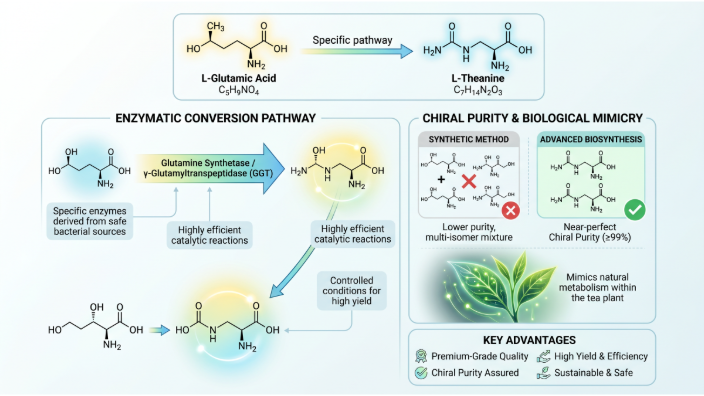
Economic and Purity Metrics: The Hard Data
The data comparison between the two methods reveals a significant trade-off between initial cost and final efficacy. Chemically synthesized theanine often results in a "racemic mixture" of both L-theanine and D-theanine in a 50/50 distribution unless expensive chiral separation is performed. Current market data shows that while standard chemical synthesis can reduce production costs by approximately 30% to 40% compared to enzymatic routes, the bio-availability tells a different story. In the market for L-theanine raw material bulk, buyers often face a price-quality dilemma: cheaper synthetic material may seem attractive upfront, but its functional drawbacks become evident in clinical applications. In clinical absorption tests, enzymatic L-Theanine showed a 98% absorption rate within the first 60 minutes, whereas non-separated synthetic mixtures plateaued at 45% due to D-isomers clogging transport receptors. For high-end formulations, the 20−30 per kg premium for biosynthetic material is offset by a 100% increase in functional potency. When choosing Non-GMO L-theanine bulk, the absence of genetic modification in the bacterial enzymes (or fermentation hosts) further appeals to clean-label formulators and eco-conscious brands. This added assurance justifies the investment for premium segments.
The Future of Scalable Manufacturing
As the demand for "Clean Label" products rises, the industry is shifting toward fermentation-based biosynthesis. This method combines the cost-efficiency of large-scale production with the uncompromising purity of biotechnology. While traditional tea extraction yields Organic L-theanine tea extract, its scalability is limited by seasonal harvests and low extraction efficiency. Fermentation-based biosynthesis, however, can produce pure L-theanine year-round without relying on tea leaves, while maintaining organic certification if GMO-free inputs are used. Supplier owners must emphasize these technical nuances to differentiate themselves in a crowded marketplace where "synthetic" is becoming a liability.
Leadingnutra: Green Tea Extract L-Theanine
At Leadingnutra, we deliver premium green tea extract L-Theanine(https://www.leadingnutra.com/L-Theanine.html) with uncompromised purity and sustainable sourcing. Contact us for certificates, samples, or bulk quotations – your trusted partner in clean-label cognitive ingredients.
[1]National Center for Biotechnology Information (NCBI): L-Theanine Production Methods.
[2]Journal of Functional Foods: Comparative Bioavailability of L-Theanine Isomers.
[3]World Health Organization (WHO): Food Additives Series - Theanine Safety Profile.
[4]U.S. Food and Drug Administration (FDA): GRAS Notice for L-Theanine.
[5]European Journal of Clinical Nutrition: L-Theanine and Cognitive Function.