The Technical Evolution of Rhodobacter sphaeroides in High-Yield CoQ10 Bioproduction
05/21/2026 10:04:29
The industrial production of Coenzyme Q10 (CoQ10) is a testament to the power of precision microbiology. At the heart of this billion-dollar industry lies Rhodobacter sphaeroides, an α-proteobacterium renowned for its exceptional capacity to synthesize isoprenoids. For R&D experts, understanding the technological evolution of this host organism is the key to decoupling yield constraints from production overhead. Today, Sustainable CoQ10 Ingredient Sourcing has become a driving force, pushing manufacturers to adopt microbial fermentation over chemical synthesis or animal extraction — a shift that reduces environmental footprint while ensuring batch-to-batch consistency.
Over the last decade, the methodology for leveraging R. sphaeroides has transitioned from traditional phenotypic screening to sophisticated metabolic flux analysis (MFA). This evolution has redefined the benchmarks for CoQ10 output.
Decoding Metabolic Hub Redirecting Mevalonate Pathway Co Q10
The core secret to high-yield CoQ10 production lies in the redirection of metabolic flux toward the synthesis of decaprenyl diphosphate (DPP). Traditional strains of R. sphaeroides naturally produce CoQ10, but at levels far below commercial viability. By introducing strong constitutive promoters to genes like dxs and idi, engineers have successfully forced a “metabolic bottleneck” bypass. Data analysis shows that whereas wild-type strains exhibit a specific CoQ10 content of approximately 2-3 mg/g DCW, hyper-producing engineered strains now consistently exceed 85 mg/g DCW — a nearly 30-fold increase in cellular density. Furthermore, the resulting Microbial Fermented CoQ10 Bulk offers superior purity and bio-identity compared to semi-synthetic alternatives, making it the preferred choice for premium nutraceutical formulations.
Precision Strain Selection and Stability: From Traditional Mutagenesis to Directed Engineering
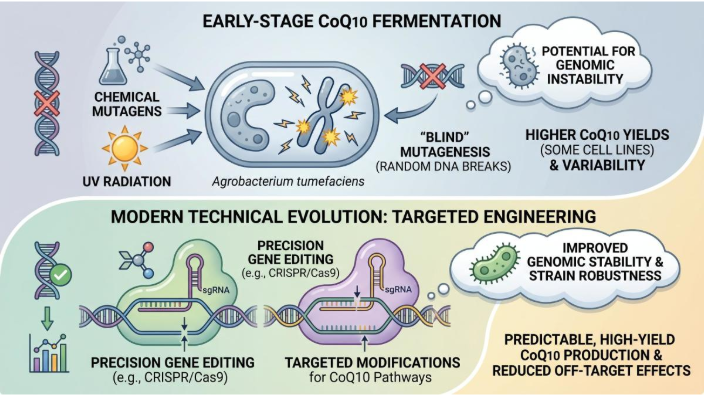
Early-stage CoQ10 fermentation relied heavily on chemical/UV mutagenesis. While effective, these “blind” methods often introduced genomic instability. Modern technical evolution has shifted toward “targeted engineering” enabled by CRISPR/Cas9. We can now pinpoint the exact metabolic suppressors that inhibit ubiquinone synthesis under high-aeration conditions. By silencing competitive pathways, production teams have achieved a “directed flux” where over 65% of available isoprenoid precursors are channeled exclusively into CoQ10 synthesis. This precision ensures that 200,000-liter scale fermentation remains as stable as the lab-scale pilot, with deviation rates dropping to less than 2% between batches. The output is a Bio-identical Coenzyme Q10 Ingredient that perfectly mimics the endogenous human molecule, maximizing bioavailability and safety for dietary supplements.
Shortening Fermentation Cycles: The Intersection of Biokinetic Engineering and Yield Efficiency
Beyond the genetic blueprint, the evolution of the fermentation environment itself has played a critical role. The latest technical standard involves a strategy of “Two-Stage Aeration Control.” In the initial growth phase, dissolved oxygen (DO) is maintained at 40% to rapidly build dry cell weight. In the second phase, DO is precision-throttled to 10-15% to trigger the physiological stress response that stimulates CoQ10 accumulation. This shift has shortened the typical fermentation cycle from 120 hours down to 84 hours, representing a 30% increase in factory throughput. Industrial data indicate that the use of specialized nitrogen source cocktails has increased the specific production rate from 0.8 mg/L/h to over 3.5 mg/L/h . After downstream processing, we obtain Reduced Coenzyme Q10 98% Purity — a highly stable, active form of ubiquinol that meets the strictest quality standards for anti-aging and energy-support products. For formulators seeking Bulk Ubiquinol for Anti-aging Supplements, this level of purity eliminates unwanted byproducts and ensures consistent clinical efficacy.
Leadingnutra your one-stop partner for premium Coenzyme Q10 ingredients(https://www.leadingnutra.com/CoenzymeQ10.html), from microbial fermented bulk to reduced ubiquinol. Contact us today to request samples and elevate your anti-aging formulations.
[1] Nature Communications - High-yield polyisoprenoid production.
[2] Journal of Biotechnology - Metabolic flux redirection strategies.
[3] ACS Synthetic Biology - Engineering isoprenoid production in Rhodobacter.
[4] Biotechnology Advances - Sustainable bioprocesses for coenzyme Q10.