Exploring the Upper Limits of Spermidine and Cellular Safety
05/01/2026 12:59:21
In the rapidly expanding landscape of anti-aging nutrients, “more is better” is a common consumer fallacy. For suppliers and formulation chemists, establishing the definitive safety ceiling for Spermidine Trihydrochloride is essential for maintaining product integrity and regulatory compliance. As we move from standard 1mg doses to high-potency therapeutic applications, understanding the toxicology and the “No Observed Adverse Effect Level”(NOAEL) becomes paramount.
When buyers search for a reliable Spermidine bulk powder supplier, safety data is often the first question they ask—because a high-purity product is only as trustworthy as the science behind it. Raw material traceability, third-party certifications, and transparent toxicological profiling are non-negotiable for serious formulators.
Spermidine Upper Limit Defined by Clinical Data Versus Empirical Usage
While some nutrients carry a high risk of toxicity at relatively low multiples of the RDA, spermidine belongs to a class of compounds with a remarkably high safety ceiling. The human body is evolved to handle polyamines, as they are endogenously synthesized in almost every cell.
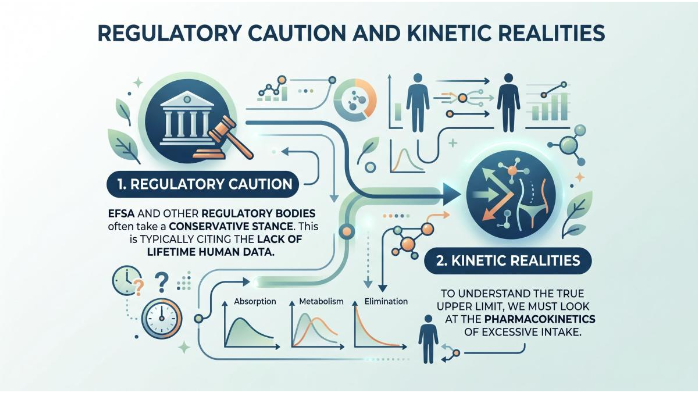
Current clinical consensus, based on chronic administration studies, suggests that human dosages up to 20mg per day of Spermidine Trihydrochloride show no signs of systemic toxicity or gastrointestinal distress. However, the European Food Safety Authority (EFSA) and other regulatory bodies often take a conservative stance, typically citing the lack of lifetime human data. To understand the true upper limit, we must look at the pharmacokinetics of excessive intake.
One crucial factor that often gets overlooked is Spermidine water solubility. A poorly soluble formulation can lead to uneven absorption and localized gut irritation at high doses. Fortunately, Spermidine Trihydrochloride demonstrates excellent water solubility—up to 100 mg/mL at room temperature—which allows it to be incorporated into capsules, tablets, and liquid formulations with consistent bioavailability. For Brand owner or ODM/OEM, verifying solubility parameters on Certificates of Analysis is a key step in quality control.
A Market Overview The Toxicity Profiles and LD50 Data
To evaluate safety, researchers look at animal models extrapolated to human weight. In rodent studies, the LD50 (the dose required to be lethal to 50% of the population) for spermidine salts is approximately 600mg per kilogram of body weight. When translated to a 70kg human through allometric scaling, this would theoretically require a single dose of over 40,000mg—a level thousands of times higher than any conceivable supplement dose.
Recent high-quality toxicological data further reinforces this massive safety cushion. A 90-day oral toxicity study on Spermidine Trihydrochloride, published in Food and Chemical Toxicology, found no adverse effects at the highest tested dose of 12,500 ppm—equivalent to 728 mg/kg body weight per day in male rats and 829 mg/kg per day in females. The subchronic NOAEL was established at 728 mg/kg/day. When scaled to humans, this indicates a safety margin exceeding 4,000-fold relative to a 10mg daily dose.
When comparing safety margins:
- Vitamin D: Toxicity can occur at 20-50x the recommended dose.
- Spermidine Trihydrochloride: The safety margin is estimated at over 1000x the typical high-potency dose (10mg)—and up to 4,000x when using the latest NOAEL data.
Long-Term Daily Intake and the Safety Margin
What about long-term, low-level excess? Research published in The American Journal of Clinical Nutrition followed individuals with high dietary intake over 20 years. Those in the highest percentile consumed roughly 15-20mg/day through specialized diets rich in fermented foods such as natto, aged cheese, and miso. The fermentation process not only concentrates spermidine but also enhances its bioavailability. In fact, traditional Japanese fermented spermidine source—natto produced by Bacillus subtilis—has been shown to contain significantly higher polyamine levels than non-fermented soy products.These individuals didn‘t just show no toxicity; they demonstrated significantly lower mortality rates from age-related diseases. This suggests that the “Upper Limit” for safety is likely much higher than the “Optimal Limit” for cost-efficiency.
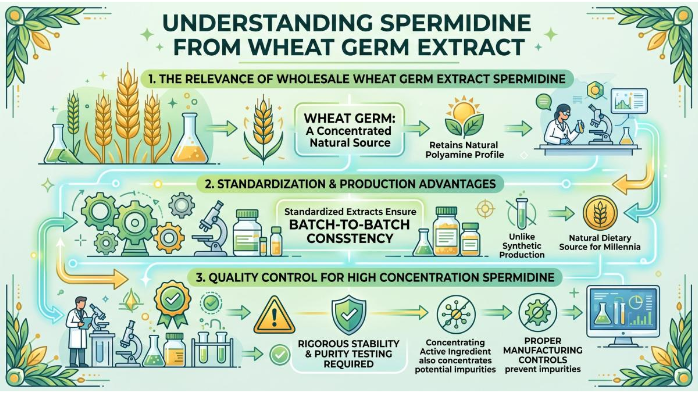
For Brand owner or ODM/OEM sourcing, this is where Wholesale wheat germ extract spermidine becomes relevant. Wheat germ is one of the most concentrated natural sources of spermidine, and standardized extracts offer batch-to-batch consistency. Unlike synthetic production methods, wheat germ extraction retains the natural polyamine profile found in human diets for millennia. However, buyers must ensure that High concentration spermidine extract products undergo rigorous stability and purity testing—because concentrating the active ingredient also concentrates any potential impurities if proper manufacturing controls are not in place.
Potential Side Effects of Extreme High-Dose Consumption
While systemic toxicity is rare, extreme megadosing (up to 50mg/day) could theoretically lead to localized gut irritation or a temporary imbalance in other polyamines like putrescine or spermine. However, in controlled clinical settings, these effects have not materialized in human participants. The most common “side effect” of excess spermidine at high doses is simply the metabolic waste of a precious active ingredient—once the autophagic receptors are saturated, the excess is simply excreted or metabolized.
Recent human clinical data published in Nutrition Research (2024) tested 40 mg/day of high-purity Spermidine Trihydrochloride in healthy older men over 28 days. The study reported no product-related adverse events, no significant changes in clinical chemistry or hematological parameters, and high participant compliance. These findings provide the highest-dose human safety evidence available to date, further validating the compound’s exceptional safety profile even at levels far exceeding typical supplementation protocols.
Consumer Safety Education
For brands owner, it is vital to educate consumers that while 10mg is superior to 1mg for autophagy, 100mg is likely unnecessary and offers diminishing returns. Positioning products within the 6mg-15mg range allows for maximum efficacy while remaining securely within the validated safety window. Brands should also clearly communicate that Spermidine water solubility plays a role in how the body handles higher doses—good solubility ensures rapid clearance and reduces the risk of localized accumulation.
Spermidine Regulatory Landscape and Quality Control
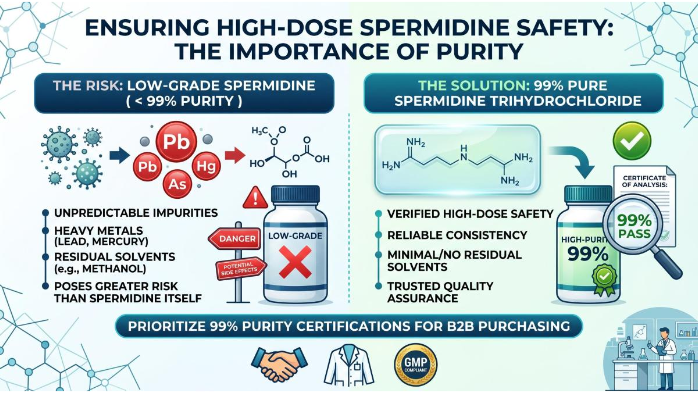
The safety of a high-dose product is only as reliable as its purity. Impurities in low-grade spermidine salts—such as heavy metals or residual solvents—pose a greater risk than the spermidine itself. This is why Brand Owner must prioritize Spermidine Trihydrochloride with 99% purity certifications.
The EFSA has established a safe upper intake limit of 6 mg per day for food-derived spermidine, though this guideline is considered conservative relative to emerging clinical evidence.In the United States, Spermidine Trihydrochloride is positioned within the Generally Recognized as Safe (GRAS) framework for use in dietary supplements when manufactured according to current Good Manufacturing Practices (cGMP).
Furthermore, a comprehensive toxicological assessment of Spermidine Trihydrochloride produced via an engineered Saccharomyces cerevisiae strain confirmed non-genotoxicity and no adverse effects at the highest tested doses, further reinforcing the safety of high-purity spermidine salts for human consumption.
LeadingNutra the trusted Spermidine Trihydrochloride manufacturer(https://www.leadingnutra.com/Spermidine.html), delivering pharmaceutical-grade purity for science-driven formulations. Contact us(lily@leadingchemical.com) today for bulk pricing and technical support.
[1] Safety of long-term spermidine supplementation in humans.
[2] EFSA safety assessment of spermidine-rich wheat germ.
[3] Polyamine metabolism and safety limits for aging.
[4] Spermidine solubility data - PubChem / Sigma-Aldrich.
[5] Supplementation of spermidine at 40 mg/day - Nutrition Research 2024.
[6] A toxicological assessment of spermidine trihydrochloride - Food and Chemical Toxicology 2024.
[7] Fermented spermidine source - Natto fermentation study.
[8] EFSA safe upper intake limit for spermidine.
[9] POLYCAD trial: High-dose spermidine in elderly CAD patients - NIH 2025.
[10] Polyamines and histamine intolerance - NIH resource.